A Day at Casa Alianza Mexico On August 4, 2016, we had an 8:00 a.m. meeting with the teams at Casa Alianza Mexico. We met Jessie and Aidee, who organized this day for us—two lovely young women whose helpfulness and professionalism we’ve appreciated over the past few weeks through our email and phone exchanges.
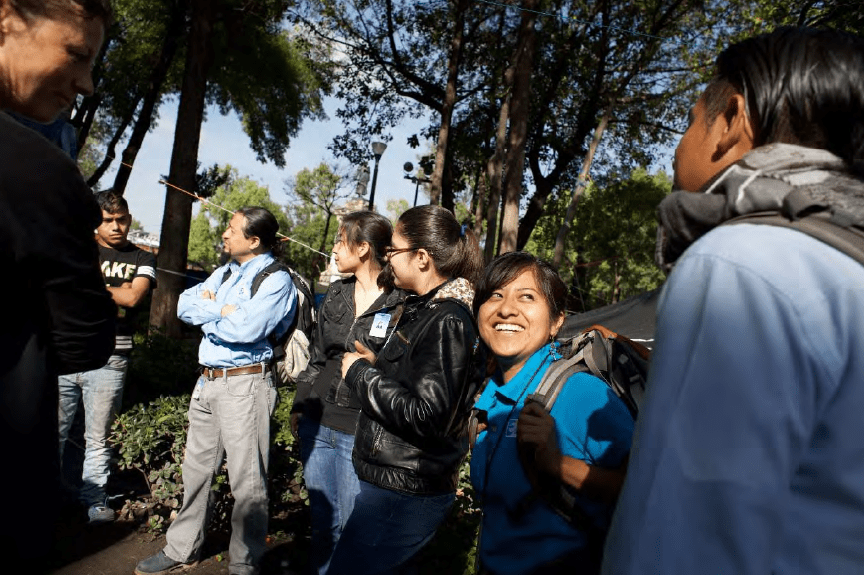
With them, we spent the morning shadowing the educators Carla, Jorge, and David. Each carried a backpack containing first-aid supplies, games, a notepad, and a pen. They wore a shirt and a Casa Alianza badge.
Their daily work involves reaching out to children on the streets of Mexico City; they make up the Street Team. They offer a supportive presence, comfort, and assistance. To children who might be interested, they talk about the day center and invite them to come there to relax or even begin the process of reintegration.
They visit 70 areas every month to meet with the 300 children they support. Of these, 150 have already passed through the pre-communidad center, and 50 have been welcomed into the various Casa Alianza Mexico residences. A large center with 190 beds is under construction and scheduled to open in January 2017 to accommodate more young people.
Casa Alianza’s policy is to help children get off the streets. The educators do nothing that might encourage them to stay there: they do not distribute food or clothing. Instead, they help them obtain official documentation, which involves extensive administrative procedures once family ties have been reestablished—the first major hurdle, since many of them and their parents have never been registered anywhere.
We follow them and arrive at the Plaza del Pueblo, where street dwellers and striking teachers mingle.
Mama Dulce has three children aged 6, 7, and 8 and is expecting her fourth. She lives with her husband, Jamilet, and another 19-year-old whom she considers her son—he already has a partner and children.
This extended family lives under tarps in a tent next to the protesters.
Mama Dulce makes it a point of honor to educate her children, sending them to the neighborhood school properly dressed while they wait for housing that remains uncertain.
We pass by another large tent where another group lives. Two young men are still dozing, and we meet a third who comes over when he sees us. He tells us about his problems with alcohol and drugs, and how he can’t seem to get his life together.
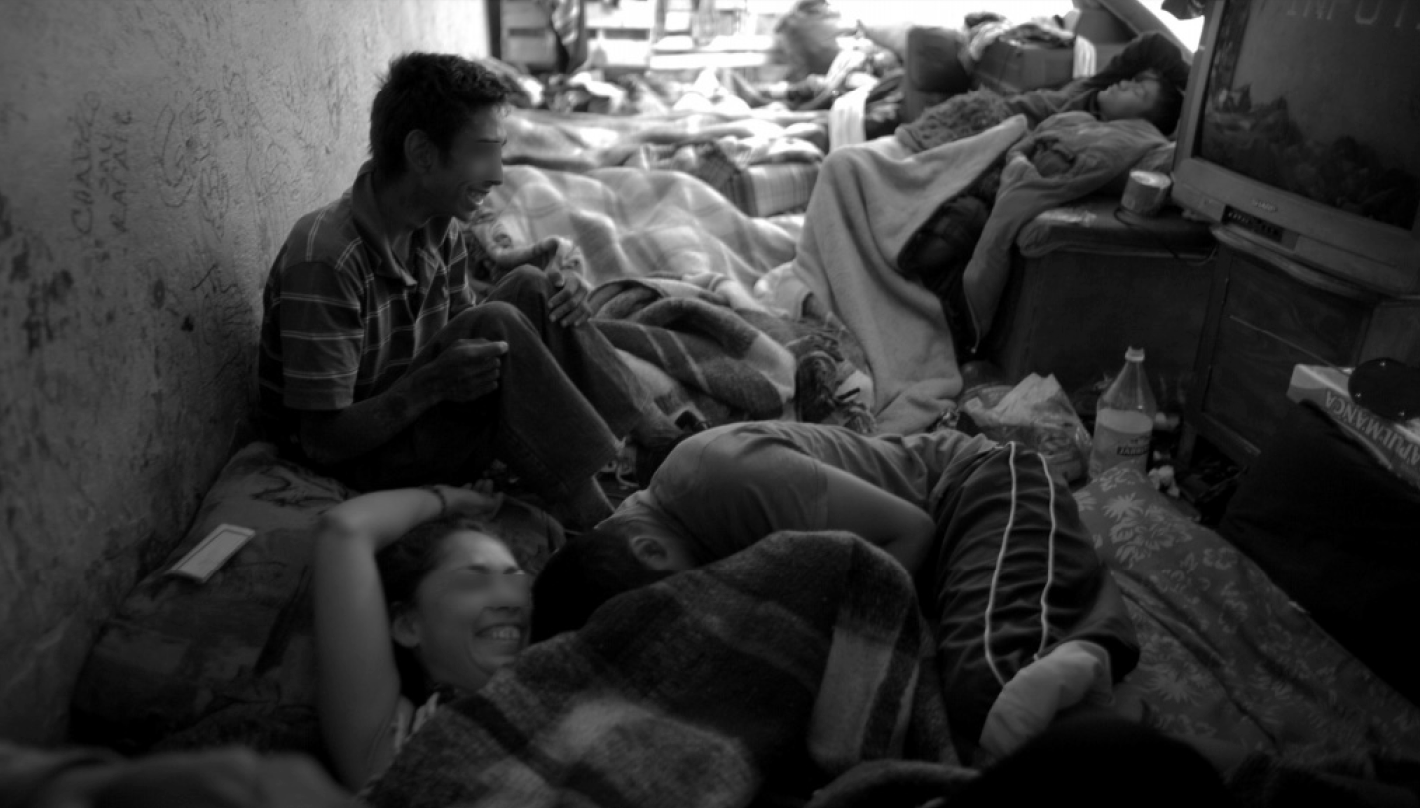
At a nearby street corner, we step under a tarp stretched against a wall on a wide sidewalk. About twenty young men and a few young women are still asleep. Mattresses on the floor, blankets with holes in them, piles of clothes, a TV that’s on but not working, and drink spills on the ground.
David warns us that we’ll have to leave quickly if he senses any unease caused by our presence. A few young people wake up, surprised to see us, but are quickly put at ease by David and Jorge’s presence. One young woman hides under her blanket, but the others join the conversation. They’re laughing and agree to have their pictures taken. We’re aware of the problems facing this kind of group: the ravages of drugs and alcohol, STDs and unwanted pregnancies, and stab wounds that don’t heal properly due to a lack of medical care.
After a while, we have to leave at David’s request.
While waiting for David, we talk with Helminda, who is sitting on the street under the influence of drugs. She tells us she is 26 years old, works as a sex worker, has been pregnant five times, has lost four babies, and one was adopted. She’s made a few attempts at rehab but is still living on the street. This young woman bears the scars that tell the story of her life, and she maintains a faint smile as she tells us about her search for a new treatment center. We’ll see her again the next day in the same spot, but she doesn’t recognize us.
A teenager joins us in a square a little further away, her dog right on her heels; her name is Alundra. She doesn’t seem bothered by our presence and jokes with David because she still hasn’t come to the pre-community center. We know that this would require a stay in a clinic for detox first, leaving her clan and her street behind. We understand how difficult Casa Alianza’s work is. Alundra doesn’t want to leave this world where she sells herself to buy drugs for herself and her loved ones, where violence is a daily reality. This is her life; she doesn’t know any other. She loves her clan and her dog. She’s 13 years old.
We play a little game with her where we have to replicate structures within a time limit. For a few minutes, she becomes a child again; she laughs and sets aside her hand holding the ether-soaked rag—even though Carla sometimes stops her from putting it to her nose—to lift her spirits and give her a few moments of childhood in her day.
After picking up our three children at the hotel, we head to the first center we’re visiting that afternoon.
Thirty children and teenagers visit this pre-community center each day, which offers workshops in the morning and afternoon. It’s an opportunity for them to take a shower, eat a snack prepared by Gaby—who has been working in the kitchens for four years—borrow clothes, and have their first taste of a more conventional life. In fact, the young people know that to attend, there are a few non-negotiable rules: no sex, no drugs, no violence. If these rules are broken, an educator explains them again to ensure the child or teen has understood them and, if necessary, asks them to leave and return the next day.
The workshops take place in a room, around a large table. The young people do fun exercises to learn the basics of math, geography, and drawing—and, above all, to relax and laugh in a safe, age-appropriate environment. Upstairs, a space has been set up for them, complete with a foosball table, books, games, and fold-up mattresses.
This center also allows young people to have individual counseling sessions, and Casa Alianza’s educators coordinate with other rehabilitation organizations.
Incorporating this center into their daily routine helps children and adolescents navigate various important stages. They begin to learn about rules and discipline. Their life on the streets has taught them to survive through violence. They want everything immediately; otherwise, they become confrontational. At this center, they can take their time, build self-confidence, and gradually become calmer. Learning to follow a few rules and respect others prepares them for community life in the residential homes.
The primary learning tool is play within a cognitive therapy framework. Weekdays are quite busy, but weekends are more relaxed, with candy and rewards handed out.
After this visit, we head to a center where teenagers live.
Thirty-five boys up to age 18 live at Communidad Cenzontle Paloma to continue their reintegration and prepare for adult life off the streets.
Upon arriving at this center, we attract comments and curious stares.
They’re waiting for us, all gathered in the large living room. We introduce ourselves one by one—the staff, the boys, and then us. These young people are quite well-behaved; we sense that strict discipline is essential at this center, even though laughter often breaks out. They’re between 11 and 18 years old. All of them attend school, and we know that they’ve all successfully completed the first step, which allows them to look forward to vocational training and an independent life afterward.
Upon arrival, it takes 15 days for them to fully understand the rules and begin to follow them.
Nineteen boys live on the first floor, in dorms with 1 to 4 beds. This is where they are housed upon arrival and during the early stages of their life at the center.
All the dorms are tidy. Each boy has a space for his clothes and personal belongings. The beds are made, the shelves are organized, and the decor is typical of a teenager’s room, with drawings and posters.
The second floor is reserved for boys who have fully adjusted. Being allowed to move there is a sign of recognition. Ten young people live there, having internalized the center’s rules and values. They attend school or are enrolled in a training program.
No later than the day before their 19th birthday, the young people must leave the center. Casa Alianza continues to support them for another 10 months.
A shy young man who has been training to become a computer repair technician for nine months refuses to be photographed. Garrett is 15 years old; he knows how lucky he is to be there while still being able to spend his weekends at his grandmother’s house.
Twelve girls live in a house that can accommodate 16, the Communidad Quetzal.
The atmosphere is calmer, thanks to the manager’s guidance.
The girls are between 12 and 17 years old. Just like with the boys, we sit in a circle to introduce ourselves, one after another. They come from all walks of life. Rosa is 17 and comes from Usulután, El Salvador. She tells us that she left her hometown with her father and mother to go to the United States. They never made it there, and the family is now separated. Her father is in Guatemala, and her mother is in another city in Mexico. The girls are cheerful and seem comfortable speaking in front of us, even though some of them remain quieter.
Hogar Quetzal is the last home we visit, designed for 12 girls between the ages of 15 and 18. Only one is present; the others are at a market. At this center, the girls are ready to spread their wings, even though stuffed animals still sleep in their beds.
Throughout the day, we experienced a range of emotions. Sadness and outrage at seeing so many children and young people left to fend for themselves on the streets, in dire conditions—addicted to drugs, forced into prostitution, their bodies marked by scars and wounds.
Amazement at seeing that, despite everything, they remain cheerful, eager to talk and tell us about their lives. This is their world, the way they function, and even though the streets are filled with violence that leaves physical and psychological scars, they know no other way and have grown accustomed to it. They talk about improving their daily lives, but integrating into a different social model would mean leaving their own—their clan, their dog, their addiction—and losing the hideouts and the relative emotional security they’ve found. Meeting with them regularly—to talk, play, and update them on the progress of the administrative hurdles involved in obtaining an ID for them—is essential and beneficial for them.
We were impressed by the professionalism of everyone we met. The educators, led by David, have proven experience. We felt completely safe during our day with them. Every child and adult we met is treated with the utmost respect and humanity, and a heart-to-heart approach seems to be their guiding principle in their professional lives.
We discovered just how well-structured Casa Alianza is in supporting children and adolescents, whether on the streets or in its centers. The rules are clear, and the process is detailed and very pragmatic. The children they take in are guaranteed support through adulthood and beyond, in a warm, extended-family-like environment.
We witnessed the implementation of Casa Alianza Switzerland’s projects and came to understand just how much everything depends on the professionalism of the people dedicated to this mission with the children, whether on the streets or in the centers. We realized just how important the continued financial support provided by Casa Alianza Switzerland to Casa Alianza Mexico is for this organization, which, thanks to us, is committed to helping these children and cannot abandon them along the way. We also realized just how much Carla, Jorge, David, and everyone else deserve our support in their mission.
Thank you to Margot, Jessie, Aidee, Carla, Jorge, David, and everyone who made it possible for us to experience this day, which will remain forever etched in our hearts.
Valérie Tabachnik Podesta - December 2, 2016